TL;DR
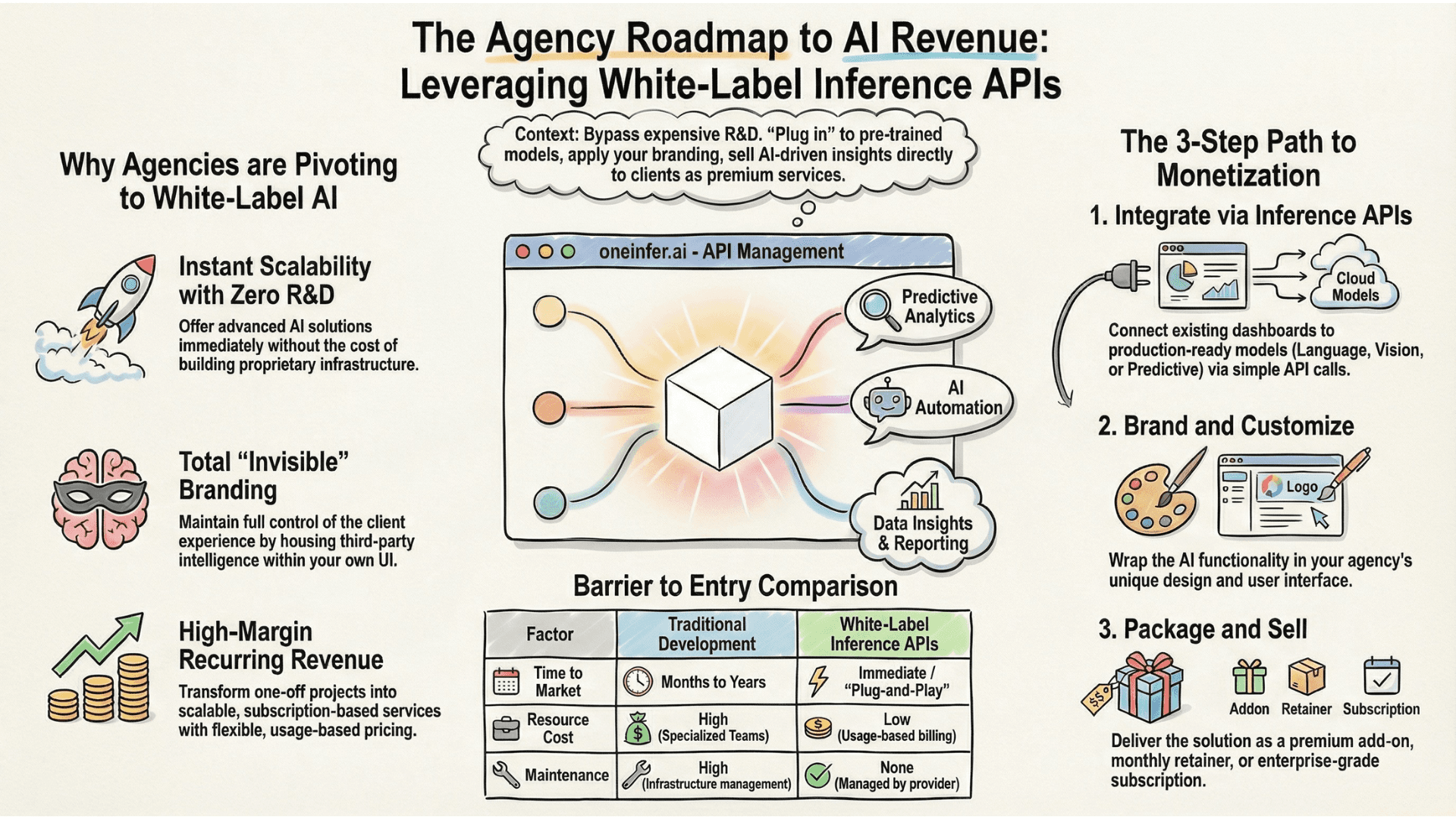
Agencies are winning AI contracts without ML teams by white-labeling unified inference APIs. The four highest-value service lines are intelligent content generation, conversational AI on client knowledge bases (RAG), predictive analytics, and personalization engines. The commercial model is implementation fee + monthly managed retainer + infrastructure margin on inference usage — recurring revenue with near-zero marginal cost.
The White-Label AI Opportunity in 2026
The digital agency landscape has fundamentally shifted. Clients who two years ago asked about mobile responsiveness now ask about AI personalization, automated workflows, and intelligent customer interactions. Agencies that respond credibly capture contracts traditional development shops can't access.
The historical barrier was infrastructure. Training custom models needs data science. Deploying inference needs MLOps. R&D timelines exceeded contract windows. White-label inference APIs eliminate all three. Production-ready models — language, vision, multimodal, recommendation — accessible via API. The provider manages all infrastructure. The agency handles integration, branding, delivery. The client sees an agency-branded AI product.
What White-Label AI Actually Means in Practice
White-labeling AI does not mean reselling API access with your logo on the dashboard. That's reselling, not white-labeling. Clients recognize the difference.
True white-label AI means integrating inference so deeply into the client's product or workflow that the AI behavior feels native to the brand and purpose-built for the use case. The user interacts with "SmartSearch by ClientCo" — not a generic chatbot.
Three layers of customization beyond the base model call: (1) prompt engineering and system instructions constraining model behavior to client context — tone, terminology, content policy, domain knowledge; (2) product interaction layer fitting client UI/UX patterns; (3) feedback loops capturing client-specific usage data.
OneInfer's unified inference API is designed specifically for this pattern. The OpenAI-compatible endpoint means agencies write integration once and deploy across multiple client engagements with different model configurations — switching between Llama 3, GPT-4o, Claude 3.5 Sonnet, Mistral Large with one parameter change.
The Four Highest-Value AI Service Lines for Agencies
1. Intelligent content generation and optimization
Content production is universal pain. Brief-to-draft, SEO optimization, multi-channel adaptation, brand voice consistency — immediate measurable value clients understand intuitively. Highest-leverage extension for agencies already providing content services.
2. Conversational AI and intelligent customer support
Most common white-label AI engagement in 2026. Ingest client knowledge into vector DB, deploy RAG on foundation model, wrap in client-branded UI. Pinecone is the production standard for knowledge ingestion.
3. Predictive analytics and intelligent reporting
Clients with data but not analytical capacity to extract insight. Natural language query interfaces, anomaly detection, trend modeling. Transforms data into active business intelligence without clients hiring data scientists.
4. Personalization engines
Recommendation systems, dynamic content personalization, behavioral targeting via inference APIs deployed as managed services across e-commerce, media, SaaS. Agency owns ongoing optimization relationship.
The Commercial Model That Makes This Work
Agencies extracting maximum value aren't billing for implementation hours alone. They're building recurring revenue on top of inference infrastructure.
- 1Implementation project: fixed-fee engagement for build, integration, launch. Traditional agency economics.
- 2Ongoing service layer: monthly retainer for monitoring, prompt optimization, knowledge base updates, usage analytics, iteration. Different churn dynamics than project work.
- 3Infrastructure margin: procure inference at volume from OneInfer, bill at margin for AI feature usage. Recurring revenue with near-zero marginal cost.
How to Structure Your First White-Label AI Engagement
Start with an existing client relationship and clear pain. First engagement is primarily a learning exercise — most important output is the delivery playbook you build.
Scope tightly. One well-executed AI feature improving a specific metric is more effective sales tool than five partial capabilities.
Use OneInfer's serverless tier for initial build — usage-based pricing aligns cost with client value. Migrate to dedicated endpoints when volume justifies it.
Document everything: integration architecture, prompt decisions, evaluation criteria, performance baselines. Reusable IP for next vertical engagement.
Agencies building systematic AI delivery now will have insurmountable advantage. Clients are asking today. Infrastructure is available today. The only variable is whether your agency has a credible answer. Visit oneinfer.ai or contact the team about agency partnerships.
Run multimodal AI inference at production scale
OneInfer routes every request to the optimal GPU across multiple cloud providers in real time, with sub-500ms latency, AI-generated kernel optimization, and transparent pricing.
Frequently asked questions
+What is white-label AI for agencies?
White-label AI lets agencies deliver client-branded AI features using a unified inference API behind the scenes. The agency handles integration, prompt engineering, and UX while the AI provider manages all GPU infrastructure, scaling, and model updates.
+What are the highest-value AI services for agencies to offer?
Intelligent content generation, conversational AI on client knowledge bases (RAG), predictive analytics and intelligent reporting, and personalization engines. These are the four service lines with the strongest 2026 demand and clearest ROI for clients.
+How do agencies make recurring revenue from AI?
Three layers: a fixed-fee implementation project, a monthly managed-service retainer for monitoring and iteration, and an infrastructure margin on inference usage procured at volume pricing from a unified API platform like OneInfer.
+Do agencies need ML engineers to deliver AI features?
No. With white-label inference APIs, any team that can make an HTTP request can integrate production-grade AI. Agencies need prompt engineering, integration, and UX skills — not ML engineering.
+How should an agency price a white-label AI engagement?
Implementation fee covers initial build and integration. Monthly retainer covers monitoring, prompt iteration, and feature updates. Infrastructure margin on usage covers ongoing inference cost — typically 30–50% markup over wholesale OneInfer pricing.