Key Insight
You've built your model, it's in production, and traffic is growing — and your single GPU cloud is starting to show its edges: capacity limits at peak hours, pricing that shifts without warning, and the occasional regional outage that costs you an afternoon. Multi-provider GPU routing is the standard answer to all three, and it's become table stakes for teams running inference at scale.
What is multi-provider GPU routing?
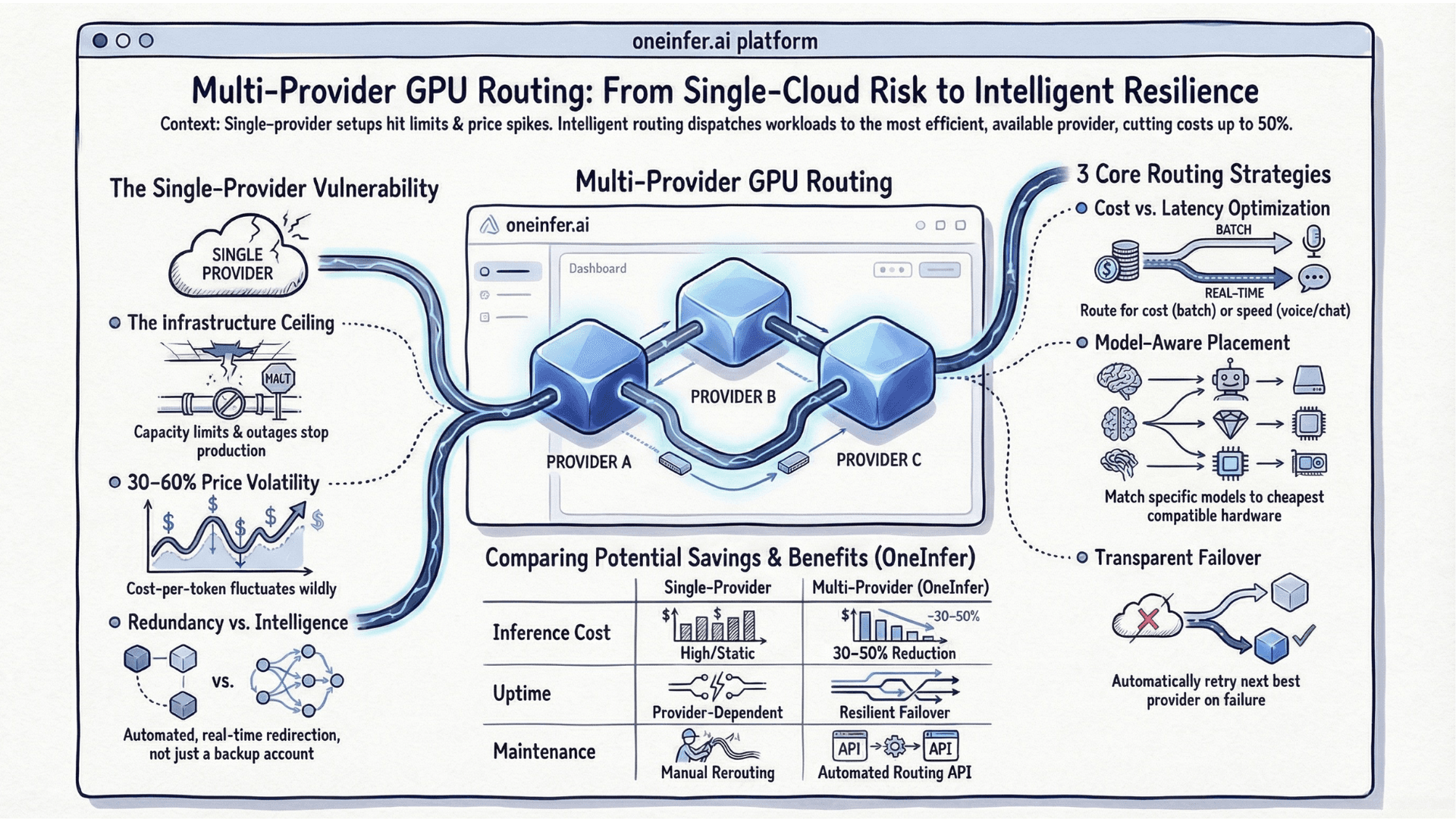
Multi-provider GPU routing is the practice of automatically directing each inference request to the best available provider in real time, rather than sending everything to one vendor. A routing layer sits in front of multiple GPU clouds and model providers, evaluates each request, and picks the path that best balances speed, cost and reliability — then reroutes instantly if conditions change.
Why single-provider inference breaks at scale
Relying on one provider concentrates three risks that all surface exactly when you can least afford them — at peak traffic:
- 1Capacity limits. When your provider is busy, your requests queue. A single vendor can't guarantee GPUs the moment you need them.
- 2Price volatility. Per-token and per-GPU-hour rates shift month to month; locked to one vendor, you pay whatever they charge.
- 3Outages. A regional incident at one provider takes your product down with it — with no fallback path.
Routing across providers turns each of these from a single point of failure into a choice the system makes for you.
How multi-provider routing works
A good routing layer makes three decisions on every request:
Latency-first pathfinding
Short, simple prompts are sent down lean, low-latency paths, while heavy reasoning is elevated to the models and providers that handle it best. The router optimizes for the response time the workload actually needs rather than a one-size-fits-all default.
Spend-aware model and provider selection
Because the same model is offered by several providers at different prices, the router can pick the cheapest capable path for each request — capturing savings that shift as provider pricing changes, with no code changes on your side.
Automatic failover
When a provider slows, hits capacity, or fails, traffic rebalances automatically to a healthy path. Your users never see the incident, and no one gets paged at 3AM to flip a switch by hand.
Key Insight
What to look for in a routing layer
- 1Real-time signals — routes on live latency, price and health, not static config.
- 2Automatic failover — reroutes without manual intervention.
- 3OpenAI-compatible API — so adopting it is a base-URL change, not a rewrite.
- 4Broad provider coverage — more paths mean better prices and more resilience.
- 5Optional dedicated capacity — the ability to pin critical workloads when you need guarantees.
Multi-provider routing vs a single provider
| Concern | Multi-provider routing | Single provider |
|---|---|---|
| Peak-hour capacity | Reroutes to available GPUs | Queues |
| Price changes | Moves to cheapest capable path | Locked to one rate |
| Provider outage | Automatic failover | Downtime |
| Latency control | Path per workload | One default |
Key Insight
— Achuth K., Co-founder & Infrastructure Lead, OneInfer
Route across providers with one API
OneInfer is OpenAI-compatible, so adopting routing is a base-URL change.
Frequently asked questions
+What is multi-provider GPU routing?
It automatically directs each inference request to the best GPU provider in real time — based on latency, cost and availability — with failover if one degrades, instead of relying on a single provider.
+Why route across multiple GPU providers?
To avoid single-provider capacity limits, price swings and outages, and to place each request on the fastest, most cost-effective path automatically.
+Does routing add latency?
A well-built router adds negligible overhead and usually reduces end-to-end latency by choosing a faster path and avoiding congested or failing providers.
+How do I adopt multi-provider routing?
Use a routing layer with an OpenAI-compatible API so integration is a base-URL and key change; existing SDK code keeps working.
Related reading: OpenRouter alternative · OneInfer Model APIs · best LLM inference API in 2026 · why AI infrastructure breaks at 3AM
About the author: Achuth K. is Co-founder and Infrastructure Lead at OneInfer, where he works on multi-provider routing and kernel-optimized inference.