Key Insight
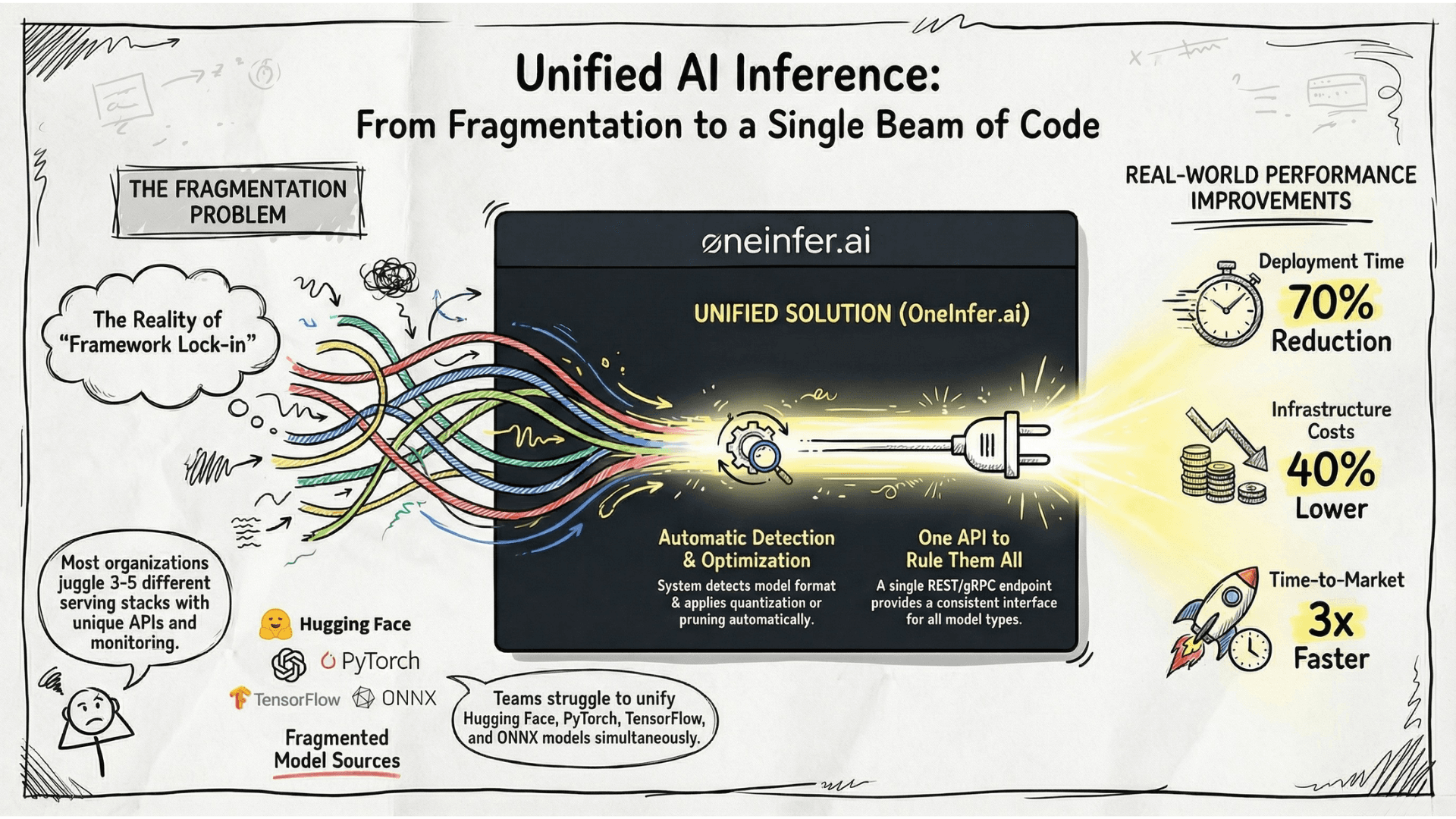
Your NLP team ships Hugging Face transformers, your vision pipeline runs a different runtime, your recommendation service runs something else again — each with its own serving stack, scaling policy, monitoring, and on-call runbook. Every new model multiplies that operational surface. A unified AI inference API is the fix: one interface in front of every model, so adding a model is a config change, not a new system to run.
What is unified AI inference?
Unified AI inference is the practice of serving any model — regardless of framework, provider, or modality — behind a single API. Instead of integrating each model or provider separately, you call one endpoint with one key, and the platform handles model access, routing and scaling underneath. When that endpoint follows the OpenAI API format, existing SDK code works against it with only a base-URL change.
The real cost of a serving stack per model
Fragmentation is expensive in ways that don't show up on a single invoice:
- 1Integration tax — every model has its own SDK, auth, and quirks to learn and maintain.
- 2Operational sprawl — separate scaling, monitoring and alerting per stack multiplies on-call load.
- 3Lock-in — code written against one provider's format is painful to move.
- 4Slow iteration — trying a new model means a new integration, so teams stop experimenting.
What a unified inference API gives you
| Capability | Unified API | Stack per model |
|---|---|---|
| Add a new model | Config change | New integration |
| Switch providers | No code change | Rewrite |
| Text + vision + audio + video | One interface | Separate stacks |
| Monitoring & scaling | Centralized | Per stack |
| Migration effort | Base-URL change | Per-provider work |
One request, every modality
The biggest advantage of a unified layer is multimodal work. Instead of stitching separate services together, a single request can see, listen, reason and respond — combining language, vision, audio and video in one coordinated flow. That's what makes agentic and multimodal products practical to build and cheap to operate.
How to migrate: one endpoint change
Because OneInfer's unified API is OpenAI-compatible, adopting it takes one change. Point your client at OneInfer and keep your existing calls:
from openai import OpenAI

client = OpenAI(
    base_url="https://api.oneinfer.ai/v1",   # one unified endpoint
    api_key="YOUR_ONEINFER_KEY",
)

# Text
client.chat.completions.create(
    model="llama-3.1-70b",
    messages=[{"role": "user", "content": "Draft a release note."}],
)

# Swap the model id to change models or modalities — same interface
client.chat.completions.create(model="whisper-v3", ...)   # audio
client.images.generate(model="flux.1", prompt="a product hero shot")  # image
Confirm exact model IDs in the API reference. Migrating from OpenAI, OpenRouter or a similar gateway is typically just a base-URL and key change.
Key Insight
— Achuth K., Co-founder & Infrastructure Lead, OneInfer
Run any model through one API
OpenAI-compatible, free to start, one endpoint for every modality.
Frequently asked questions
+What is unified AI inference?
Serving any model — across frameworks and modalities — behind one consistent, OpenAI-compatible API, so you don't maintain separate serving stacks, monitoring and runbooks per model.
+Can one API run text, image, audio and video models?
Yes. A unified inference API like OneInfer exposes text, vision, audio and video models through one endpoint and key, and can combine them in a single request.
+Is a unified inference API OpenAI-compatible?
OneInfer's is. Existing OpenAI SDK code works with only a base-URL and key change, including streaming and function calling.
+Does a unified API lock me into one provider?
No — the point is the opposite. It routes across providers underneath, so you avoid lock-in and can switch or add providers without changing your code.
Explore next: OneInfer Model APIs · Llama 3.1 API · best LLM inference API in 2026 · OpenRouter alternative
About the author: Achuth K. is Co-founder and Infrastructure Lead at OneInfer, where he works on unified, kernel-optimized inference across providers.