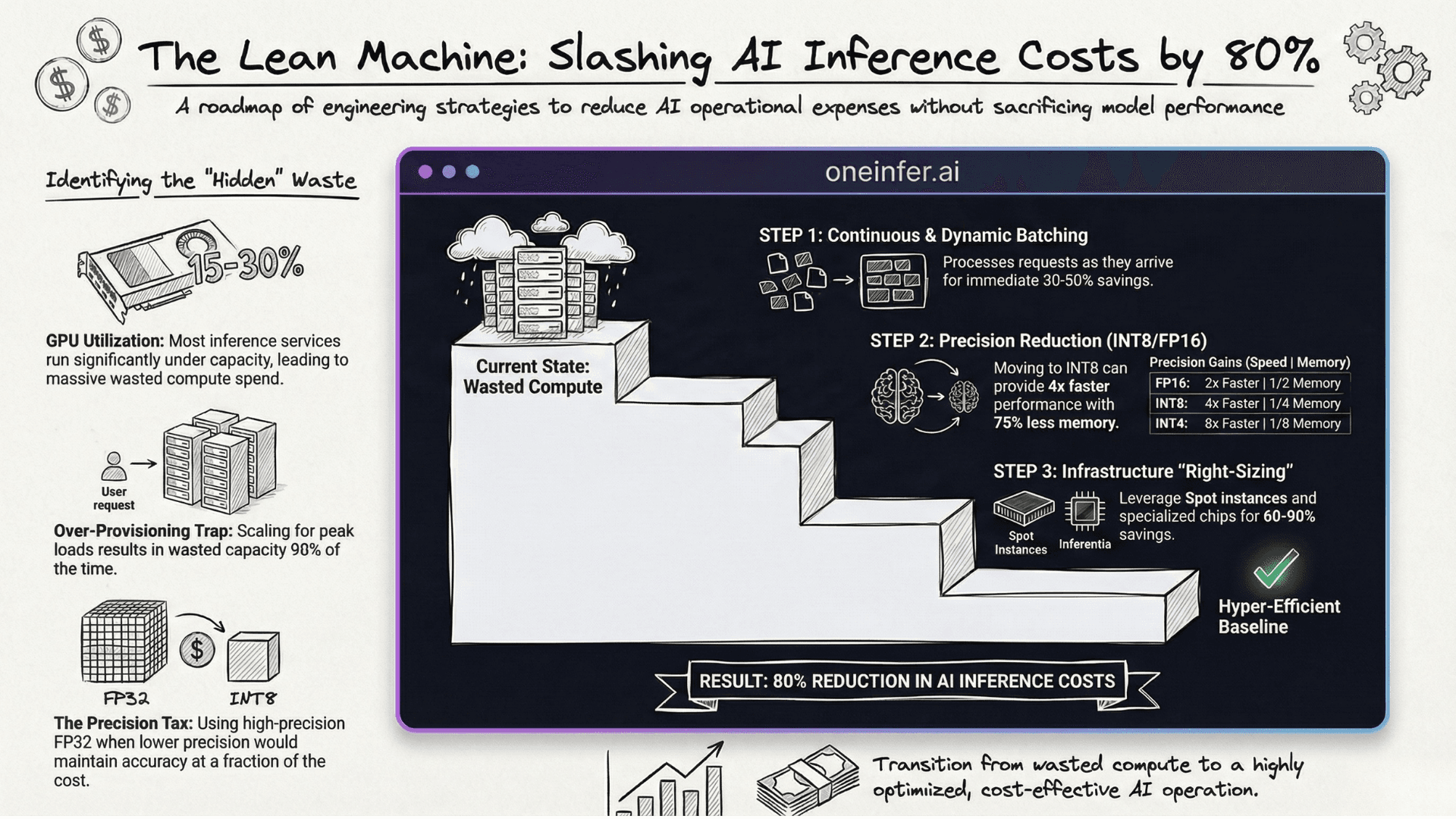
Key Insight
Most teams overspend on inference by a wider margin than they realize, and the waste is rarely in one place — it's spread thinly across every layer of the stack until the monthly GPU bill arrives and the numbers don't match the plan. The good news: because the waste is distributed, so are the wins. Six independent levers each remove a slice of cost, and they compound.
Why AI inference costs spiral
Before cutting cost, it helps to know where it leaks. In production, inference spend is driven by a handful of predictable culprits:
- 1Idle GPU capacity — replicas kept warm 24/7 for traffic that arrives a few hours a day.
- 2Oversized models — a 70B model doing work an 8B model handles at a fraction of the cost.
- 3Un-batched traffic — one request per forward pass, leaving the GPU under-utilized.
- 4Single-provider pricing — paying one vendor's rate even when a cheaper, equally capable path exists.
- 5Generic execution — stock kernels that leave throughput (and money) on the table.
Each of these maps directly to a lever below.
The six levers that reduce inference cost
1. Right-size the model
The single biggest lever is not running a bigger model than the task needs. Route simple classification, extraction and routing prompts to a small model (an 8B tier), reserve mid-size models (70B tier) for general reasoning, and only escalate to frontier models for genuinely hard tasks. Pairing model size to task difficulty often cuts token cost by 5–10× on the majority of traffic that doesn't need a frontier model.
2. Route across providers
The same open model is served by multiple providers at different prices and speeds, and those prices move month to month. A spend-aware routing layer sends each request to the cheapest capable path in real time and fails over automatically when a provider degrades — so you always pay the best available rate without re-plumbing your app.
3. Batch and cache
Batching multiple requests into a single forward pass raises GPU utilization dramatically; for non-interactive workloads, batch processing is one of the cheapest ways to serve high volume. Prompt and response caching removes repeated work entirely — identical or near-identical requests should never hit the model twice.
4. Optimize the kernels
Generic serving runtimes leave performance on the table. Per-model kernel optimization — fusing operations and tuning CUDA/Triton kernels to a model's exact tensor shapes — increases throughput per GPU, which directly lowers cost per token because you serve more with the same hardware.
5. Remove idle capacity
Paying for GPUs that sit idle overnight is pure waste. Scale-to-zero with warm-on-arrival capacity keeps cost near zero when there's no traffic while avoiding the cold-start penalty when the next request lands — you stop renting time you don't use.
6. Pick the right billing model
Per-replica-hour billing charges you continuously for every running replica regardless of how many requests it serves, so a redundant two-replica setup doubles cost immediately. Usage-based, per-token billing ties spend to actual work — usually the cheaper model unless you're running near 100% utilization around the clock.
How the savings stack to 80%
No single lever gets you to 80% — they compound. Here's an illustrative stack on a workload spending $10,000/month, where most traffic doesn't need a frontier model:
| Lever applied | Monthly cost | Cumulative saving |
|---|---|---|
| Baseline (single provider, one big model, always-on) | $10,000 | — |
| + Right-size the model on 70% of traffic | $5,500 | 45% |
| + Route to cheapest capable provider | $4,300 | 57% |
| + Batch & cache | $3,300 | 67% |
| + Kernel optimization | $2,600 | 74% |
| + Remove idle capacity | $2,000 | 80% |
Illustrative figures to show how levers compound; your mix depends on traffic shape and model choice. Model your own numbers in the LLM inference cost calculator.
Key Insight
— Achuth K., Co-founder & Infrastructure Lead, OneInfer
See your own number
Estimate current spend and potential savings in two minutes — no signup.
Frequently asked questions
+How can I reduce AI inference costs without hurting quality?
Right-size models per task (small models for simple work), route to the cheapest capable provider, batch and cache, and optimize kernels. These lower cost by improving efficiency, not by degrading output.
+Can you really cut inference costs by 80%?
In many stacks, yes — when idle capacity, oversized models, and un-batched traffic are all addressed alongside routing and kernel optimization. No single lever does it; the 80% comes from stacking them.
+What is the biggest driver of AI inference cost?
Usually model size relative to task difficulty, followed by idle GPU capacity. Running a frontier model on traffic an 8B model could handle is the most common and most expensive mistake.
+Does routing across providers reduce cost?
Yes. The same model is priced differently across providers and prices shift monthly, so routing each request to the cheapest capable path captures ongoing savings automatically.
Related reading: the real cost of running LLMs in production · how we cut GPU costs 60% · best LLM inference API in 2026 · LLM inference cost calculator
About the author: Achuth K. is Co-founder and Infrastructure Lead at OneInfer, where he works on cost-efficient, kernel-optimized inference.